Basavanna: The Vachana Poet Who Changed Kannada Literature
1131 to 1196 (traditional dates)
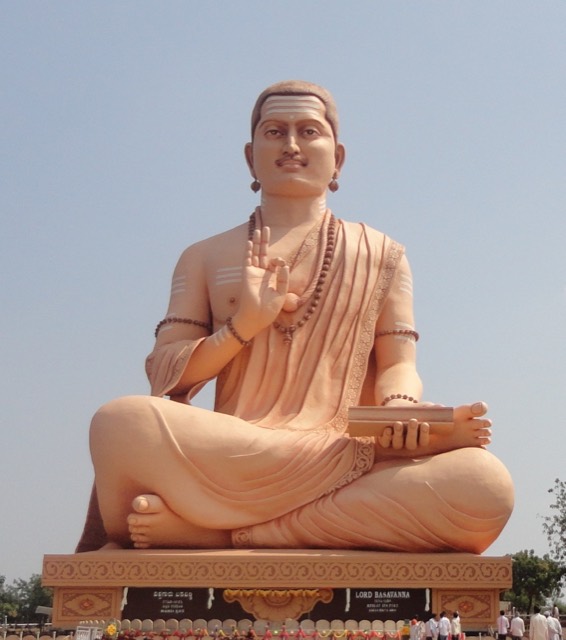
Sscheral, CC BY-SA 3.0, via Wikimedia Commons
Quick answer Basavanna (1131-1196) led a revolution in plain Kannada: vachanas, the Anubhava Mantapa and the Sharana movement. His life, famous vachanas and living legacy.
Quick facts
- Born: 1131 (traditional), Basavana Bagewadi, Karnataka
- Died: 1196, Kudalasangama
- Language: Kannada
- Known for: Vachanas, the Anubhava Mantapa, the Sharana movement
- Signature (ankita): Kudalasangamadeva, lord of the meeting rivers
- Public role: Minister and treasurer to King Bijjala II at Kalyana
In twelfth-century Kalyana, a treasury officer began writing poems that sounded like nothing Kannada had heard before. No metre. No Sanskrit ornament. No court flattery. Just a man talking, urgently, to his god and his neighbours, in the language of the street and the kitchen, each poem sealed with the name Kudalasangamadeva, the Lord of the Meeting Rivers. That officer was Basavanna, and the form he perfected, the vachana, literally a saying, rerouted the entire course of Kannada literature.
Basavanna matters to poets everywhere for a reason bigger than regional history: he proved that plain speech, pushed hard enough, becomes poetry. His vachanas argue, mock, plead and confess. They take on caste, empty ritual and his own failings with equal ferocity. Eight centuries later they are still quoted in Karnataka the way proverbs are, and they remain a masterclass in how to write a poem that sounds like a person and lands like a verdict.
A minister who wrote like a rebel
The reliable outline of his life is short. Basavanna served in the administration of King Bijjala II of the Kalachuri dynasty at Kalyana, in present-day northern Karnataka, during the twelfth century, rising by tradition to the post of chief minister or treasurer. Around him gathered the sharanas, devotees of Shiva who rejected caste hierarchy, temple monopoly and ritual mediation. He is remembered as the moving spirit of the Anubhava Mantapa, an open assembly where weavers, cobblers, boatmen and women debated spiritual experience as equals, an astonishing institution for its century.
The movement's radicalism eventually collided with the political order, and Basavanna's last years were marked by upheaval in Kalyana. But the poems survived, carried in memory and manuscript, along with thousands of vachanas by his fellow sharanas, including women poets such as Akka Mahadevi.
What a vachana actually is
A vachana is a short free-form poem in spoken Kannada prose rhythm. It has no fixed metre and no rhyme scheme, which made it revolutionary in an age when serious poetry meant Sanskrit-heavy court verse. What holds a vachana together instead is voice: the pressure of a person speaking, usually building through parallel phrases or stacked questions toward a final turn. Every vachana ends with the poet's ankita, a signature name for the divine. Basavanna's is Kudalasangamadeva, after the temple town where the Krishna and Malaprabha rivers meet.
Reading a vachana feels less like admiring an object and more like being addressed. That is deliberate. The form was built for a movement that wanted poetry out of the court and into the mouths of working people.
Signature move: the body as the temple
His most famous vachana turns on one devastating contrast. The rich, he says, can build temples for Shiva; what shall he build, a poor man? Then the turn: his legs are the pillars, his body the shrine, his head the golden cupola. And the closing paradox, addressed to the Lord of the Meeting Rivers: what is built standing still will fall, but what moves will stay. In four or five spoken breaths the poem demolishes the economics of piety and replaces architecture with a walking human being.
Study the engineering. A social observation, a personal admission of poverty, a metaphor extended limb by limb, then an aphorism that flips permanence and impermanence. No line wasted, no word above the register of daily speech. It is one of the great short poems of world literature, and it never raises its voice.
Signature move: questions that corner the listener
Basavanna loved the rhetorical question, and he used it like a prosecutor. Vachana after vachana asks the listener to explain a hypocrisy: why revere the stone god and ignore the hungry man, why value birth over conduct, why perform ritual outward show while the heart stays crooked. The questions stack, each one narrowing the room to move, until the ankita arrives like a gavel.
For your own work, notice that a question in a poem is a trap you set for the reader, and it only springs if the answer is obvious and uncomfortable. One sharp question outperforms three clever statements.
Signature move: the signature line
The ankita does three jobs at once. It seals authorship in an oral culture, the way a potter stamps a base. It works as a refrain across hundreds of poems, so each new vachana echoes every earlier one. And inside an individual poem it functions as the turn: whatever mess of anger, doubt or satire the poem has built, the moment Kudalasangamadeva is named, the poem pivots from the world to the divine and finds its footing.
Modern poets rarely use device this well. A recurring name, place or phrase across a whole collection can bind wildly different poems into one recognisable voice.
What you can learn from Basavanna
The vachana toolkit converts directly into contemporary practice, whatever you believe.
- Write one poem entirely in your spoken register; if a line would sound strange said aloud to a friend, rewrite it.
- Invent your own ankita: a name or phrase that closes several poems and accumulates meaning.
- Build a poem as an argument: observation, admission, extended metaphor, verdict.
- Use stacked rhetorical questions to corner a hypocrisy you actually care about.
- Let your final line reverse an assumption the whole poem seemed to accept.
Where to start reading
The classic English gateway is A. K. Ramanujan's anthology Speaking of Siva, which introduced vachana poetry to readers worldwide and includes generous selections of Basavanna alongside Allama Prabhu and Akka Mahadevi. In Kannada, standard numbered editions of Basavanna's vachanas are widely available and many are inscribed on walls and buses across Karnataka. Start with the temple vachana described above, then read ten more in one sitting; the cumulative voice is the real experience. If the plain-spoken style tempts you to try one of your own, a free-verse vachana of protest makes a strong contest piece, since sincerity and structure are exactly what judges reward.
Famous poems by Basavanna: The Vachana Poet Who Changed Kannada Literature
- Ullavaru Shivalaya Maaduvaru: The rich build temples for Shiva; what shall I, a poor man, build? My legs the pillars, my body the shrine, my head the golden dome. The vachana that carries his whole theology: the moving body outlasts the standing stone.
- Kalabeda Kolabeda: Do not steal, do not kill, do not lie, do not praise yourself, do not condemn others: the plain moral decalogue that Kannada schoolchildren learn as the essence of Basavanna.
- Dayave Dharmada Moolavayya: Compassion is the root of all religion: one line doing the work of a hundred sermons, quoted wherever Kannada argues about ethics.
Life at a glance
- 1131: Born at Bagewadi in northern Karnataka (by traditional accounts).
- Youth: Leaves home for Kudalasangama, the meeting of rivers whose deity becomes the signature of every vachana he writes.
- Rise: Becomes treasurer and minister in the court of King Bijjala II at Kalyana.
- At Kalyana: Convenes the Anubhava Mantapa, an open hall of spiritual experience where men and women of every caste sat and debated as equals, seven centuries before such a thing existed anywhere else.
- 1196: Returns to Kudalasangama and dies there; his memory becomes the moral centre of the Lingayat tradition.
What poets can take from this
- Read ten vachanas aloud in one sitting to feel how voice replaces metre.
- Draft a poem as a spoken complaint to someone powerful who will never hear it.
- End three different poems with the same invented signature phrase and see what accrues.
- Cut every word from a draft that you would not say across a table.
- Turn one social irritation into a single stacked-question poem.
- Study the temple vachana's structure and map your own poem onto its four steps.
Try it yourself
Write a vachana of your own: a short free-verse poem in your everyday speech that builds through repeated questions or parallel phrases and ends, every time you attempt the form, with the same signature line you invent for yourself.
Questions
What is a vachana?
A vachana is a short free-form poem in spoken Kannada, developed by the sharana poets of twelfth-century Karnataka. It uses no metre or rhyme, relies on the rhythm of speech, and ends with the poet's ankita, a signature name for the divine.
What is Basavanna's ankita?
Kudalasangamadeva, meaning the Lord of the Meeting Rivers. It refers to Shiva as worshipped at Kudalasangama, where the Krishna and Malaprabha rivers join, and it closes nearly every vachana Basavanna wrote.
Was Basavanna a poet or a social reformer?
Both, inseparably. His vachanas are the vehicle of his reform: they attack caste hierarchy and empty ritual while modelling a direct personal devotion. Kannada literature counts him as a founding poet, and Karnataka's social history counts him as a founding reformer.
What is Basavanna famous for?
Basavanna is famous as the 12th-century founder-figure of the Sharana movement and the vachana revolution: short free-verse sayings in spoken Kannada that rejected caste, ritual and temple-building in favour of work as worship. As minister at Kalyana he convened the Anubhava Mantapa, an assembly open to all castes and to women.
What is the Anubhava Mantapa?
The Anubhava Mantapa, the hall of experience, was the assembly Basavanna gathered at Kalyana where Sharana poets of every caste and both sexes, from Allama Prabhu to Akka Mahadevi, debated spiritual and social questions as equals. It is often called one of the world's earliest democratic parliaments of the spirit.
This entry on Basavanna: The Vachana Poet Who Changed Kannada Literature is maintained by the Writory editorial team for the poetry collection. Enter the poetry contest.
Current poetry contest: Enter the October round. Entries close October 25, 2026 at 11:59 PM GMT+5:30; results are scheduled for October 30, 2026 at 8:00 PM GMT+5:30. Every poem receives a five-criteria score and certificate.
Enter a Writory poetry contest
Enter the October contest and have your own poem read and scored. That first entry makes you a Writorian.