Rahat Indori: Kisi ke Baap ka Hindustan Thodi Hai
1950 to 2020
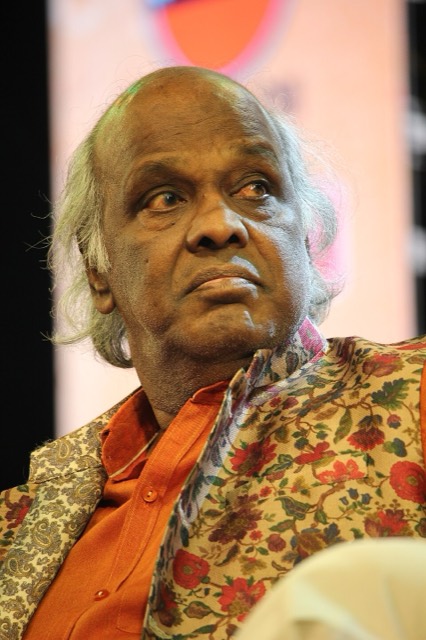
Imfarhad7, CC BY-SA 4.0, via Wikimedia Commons
Quick answer Rahat Indori (1950-2020) owned the mushaira stage for fifty years, with couplets like Bulati Hai Magar that all of India recites. His life, shayari and legacy.
Quick facts
- Born: 1 January 1950, Indore, Madhya Pradesh
- Died: 11 August 2020, Indore
- Language: Urdu
- Known for: Mushaira performance; Bulati Hai Magar; the Hindustan couplet
- Doctorate: Urdu literature, with a thesis on the mushaira itself
- Also: Bollywood lyricist through the 1990s
No Urdu poet of the internet age has been clipped, captioned and reposted like Rahat Indori. The couplet that ends with the line in this page's title, asserting that everyone's blood is in this soil and the country is nobody's father's property, became an anthem at protests across India in 2019 and 2020, decades after he first recited it. Another sher of his, beginning 'Bulati hai magar', became one of the biggest Indian memes of early 2020 for entirely unserious reasons, and he took the joke with a grin. Few poets have owned both registers at once.
Indori died in August 2020, and the videos have only multiplied since. But the videos can mislead a young writer into thinking his power was all throat and swagger. Underneath the roar was a doctorate in Urdu literature, decades of teaching, a working career as a film lyricist and a couplet-making technique of real precision. This page separates the craft from the spectacle so you can borrow the first without needing the second.
The Signboard Painter Who Took the Stage
Rahat Indori was born in Indore in 1950, the son of a mill worker, and painted signboards in his youth to help the family income, a detail he retold often and with pride. He earned a doctorate in Urdu literature and taught at college level in Indore before poetry and, later, Bombay film work took over. Hindi film listeners know his lyrics from the 1990s and 2000s even when they do not know his name.
On the mushaira stage he became something close to a phenomenon: a poet audiences travelled to see rather than merely hear. His death on 11 August 2020, shortly after announcing he had tested positive for the coronavirus, was front-page news in two countries. He had asked, in a much-shared couplet, that when he died it should be written on the sky that he belonged to everyone, and for one strange week the internet did more or less that.
Delivery as Composition
His first signature move is the hardest to see because it looks like personality: Indori composed for delivery. The famous mannerisms, repeating a first line three or four times with rising intensity, the sudden drop to a whisper, the long glare at the audience mid-couplet, were not decoration on top of the poem. The poems were engineered to create those spaces. His first lines are deliberately open, almost incomplete, so each repetition winds the spring tighter before the second line releases it.
Page poets can use this. Build your stanza so that its opening genuinely suspends, so a reader would hold their breath at the line break. Then place the release exactly where the voice would land it. Reading your drafts aloud is the cheapest revision tool that exists, and Indori is the proof of what it buys: his couplets scan perfectly for the mouth because the mouth is where they were built.
The Defiance Register
The second move is tonal. Indori's characteristic stance is the shrug of a man who has already counted the cost: lamps will keep getting lit whatever the wind decides, everyone's blood is in the soil, do what you like. The defiance never begs and never explains. Grammatically his shers of this type are built on dares and dismissals, on 'thodi hai' and 'to kya', constructions that treat the opponent's power as boring rather than frightening.
That is a genuinely original solution to a problem every political poet faces: how to confront power without sounding either shrill or noble. Indori chose contempt delivered with amusement. The couplet in this page's title works because its claim, that the nation belongs to all, is delivered not as a plea for inclusion but as a landlord's correction of a squatter. Study the confidence of the framing more than the content of the politics.
Street Idiom, Classical Bones
Third, his language. Indori's diction is aggressively colloquial: the phrase 'kisi ke baap ka' belongs to street argument, not to the perfumed lexicon of the classical ghazal, and dropping it into the form was a calculated shock. Yet his metres are strict and his rhyme discipline is old-school. The frame is classical; the paint is bazaar. That tension, formal correctness carrying informal speech, generates much of his electricity.
His image bank is worth studying too: fire, lamps, rivers, walls, the sky as a writing surface. He keeps the images elemental so the colloquial phrasing has something ancient to push against. A poem that is casual in both diction and imagery collapses into chat. Indori almost never lets both registers relax at once, and that is a rule you can apply to your own drafts tonight.
What You Can Learn
You do not need his lungs or his politics to profit from his method. The stance, the suspension and the register-mixing all transfer to any language and any stage, including the page.
- Compose aloud; if a line dies in the mouth, it was never alive on the page.
- Write an opening line that suspends rather than states, and place the release deliberately.
- Try defiance as amusement: address a fear with the tone you would use for a bore.
- Mix one street phrase into a formally strict stanza and watch the voltage.
- Keep imagery elemental when diction is casual, and vice versa.
- Test performance pieces on a live listener before calling them finished; Writory's monthly contest is a fair arena for exactly that.
Where to Start Reading and Watching
Watch first, honestly: recordings of his mushaira performances are abundant and they are the primary text. Then read the collections, 'Rut', 'Mere Baad', 'Do Kadam Aur Sahi', 'Chand Pagal Hai' and 'Maujood', available in Urdu and Devanagari editions, to see how much of the power survives without the voice. The answer, which surprises people, is most of it.
For his film work, the soundtracks of 'Munna Bhai MBBS', 'Ishq' and 'Murder' carry lyrics of his that millions can hum. Comparing a lyric of his with a sher of his is a compact lesson in how the same craftsman adjusts pressure for different vessels.
Famous poems by Rahat Indori: Kisi ke Baap ka Hindustan Thodi Hai
- Bulati Hai Magar Jaane Ka Nahin: The ghazal the internet made immortal: she calls, but you are not to go. Quoted, memed and recited by a generation that discovered Urdu poetry through it.
- The Hindustan couplet: From the ghazal identified by its closing line, Kisi Ke Baap Ka Hindustan Thodi Hai: everyone's blood is in this soil, India is nobody's father's property. Raised on placards at protests across the country.
- Lagegi Aag To: If fire breaks out, many houses stand in its path: his warning that a burning neighbourhood spares nobody, delivered with the mushaira roar that was his signature.
Life at a glance
- 1950: Born in Indore; as a teenager paints signboards to support the family.
- Study: Completes a doctorate in Urdu literature, writing his thesis on the mushaira, the stage he would rule.
- 1970s to 2010s: Five decades of mushairas across India, Pakistan, the Gulf and the West; audiences in the tens of thousands.
- 1990s: Writes Bollywood lyrics for films such as Ishq and Kareeb.
- 2020: Dies of a heart attack in Indore on 11 August, hours after announcing his Covid diagnosis to his followers himself.
What poets can take from this
- Read every draft aloud at full performance energy once, then revise for the mouth.
- Let your first line open a door without showing the room.
- Deliver conviction as a shrug, not a sermon; the unbothered voice is the loudest.
- Pair casual diction with elemental images so the poem never fully relaxes.
- Keep strict form underneath informal speech; the tension is the point.
- Do not fear being popular; being quotable and being deep are not opposites.
Try it yourself
Write a defiant poem addressed to something that intimidates everyone, an exam, a border, a hospital corridor, in the tone you would use to correct someone standing in your seat on a train. Strict rhyme, street vocabulary.
Questions
What is Rahat Indori's most famous line?
His most quoted political sher declares that everyone's blood is in this country's soil, ending with the assertion that Hindustan is nobody's father's property. It became a protest anthem in 2019 and 2020. His couplet beginning 'Bulati hai magar' separately became a massive internet meme.
Was Rahat Indori only a mushaira poet?
No. He held a doctorate in Urdu literature, taught at college level in Indore, published several collections including 'Mere Baad' and 'Chand Pagal Hai', and wrote popular Hindi film lyrics in the 1990s and 2000s. The stage fame sat on top of a full literary career.
How did Rahat Indori die?
He died in Indore on 11 August 2020, shortly after announcing on social media that he had tested positive for the coronavirus. Tributes came from across India and Pakistan, and his performance clips have circulated even more widely since his death.
What is Rahat Indori famous for?
Rahat Indori is famous as the most electrifying mushaira performer of his era and the poet of couplets that crossed over into common speech, including Bulati Hai Magar Jaane Ka Nahin and the Hindustan couplet recited at protests. He also wrote Hindi film lyrics in the 1990s.
By the Writory editorial team, reviewed by working poets. Updated October 2026.
Current poetry contest: Enter the October round. Entries close October 25, 2026 at 11:59 PM GMT+5:30; results are scheduled for October 30, 2026 at 8:00 PM GMT+5:30. Every poem receives a five-criteria score and certificate.
Enter a Writory poetry contest
Enter the October contest and have your own poem read and scored. That first entry makes you a Writorian.