Kumaran Asan: The Poet of Veena Poovu and Social Awakening
1873 to 1924
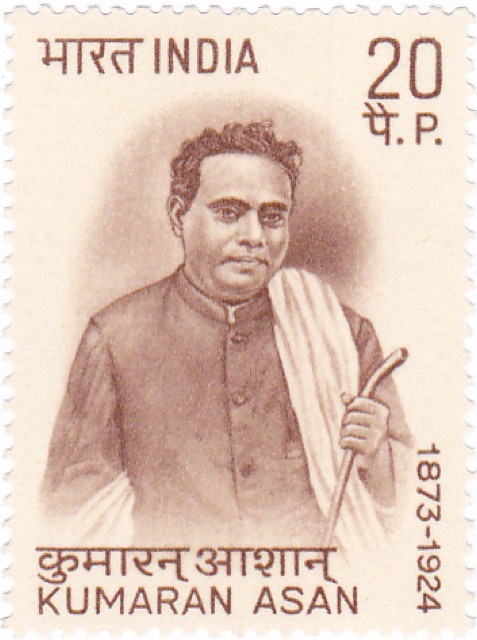
India Post, GODL-India, via Wikimedia Commons
Quick answer Kumaran Asan (1873-1924) turned Malayalam poetry inward with Veena Poovu, Chintavishtayaya Sita and Karuna. His life, famous poems, reform work and early death.
Quick facts
- Born: 12 April 1873, Kayikkara, Travancore (Kerala)
- Died: 16 January 1924, in the Pallana boat accident
- Language: Malayalam
- Mentor: Sree Narayana Guru
- Known for: Veena Poovu, Chintavishtayaya Sita, Karuna
- Public role: First secretary of the SNDP Yogam
In 1907, a poem about a flower fell into Malayalam literature and broke it open. Veena Poovu, the fallen flower, follows a single blossom from bud to bloom to the dust, and by the final stanza the flower has become every human life, its brief beauty and its unregarded end. Malayalam poetry before it was dominated by ornate courtly composition; after it, the language had discovered that a short poem about a small thing could hold a whole philosophy. The author was Kumaran Asan, born in 1873 in Kayikkara village in Travancore, and the poem announced the arrival of modern Malayalam verse.
Asan is counted with Vallathol Narayana Menon and Ulloor S. Parameswara Iyer in the great triumvirate of the Malayalam renaissance, yet he stands apart from the other two in method. He never wrote a traditional mahakavya, the sprawling classical epic that defined poetic ambition, and he was called a mahakavi anyway. Everything he needed fit inside the khandakavya, the compact narrative poem, and what he did inside that small room is the reason writers still study him.
Who Kumaran Asan Was
Asan was born into the Ezhava community, which in the caste order of nineteenth-century Kerala meant systematic exclusion from temples, schools and public roads. His life changed when he became a disciple of Sree Narayana Guru, the philosopher and reformer whose movement remade Kerala society. The Guru arranged for Asan's higher education, including Sanskrit studies in Bangalore and Calcutta, and Asan returned to serve as the first secretary of the SNDP Yogam, the organisation carrying the Guru's reform work. Poet and activist were never separate jobs for him.
His major poems arrived in a concentrated burst between 1907 and his death: Veena Poovu, Nalini, Leela, Prarodanam, Chintavishtayaya Sita, Duravastha, Chandalabhikshuki and Karuna. In 1924, at the height of his powers, he drowned when the boat Redeemer capsized at Pallana. He was fifty-one. Kerala still marks the loss; his poems sit at the centre of school and university syllabi, and the questions they raise about caste, love and impermanence have not dated.
Signature Move One: The Short Narrative With a Philosophical Core
Asan's chosen form, the khandakavya, is a narrative poem short enough to read in a sitting. His originality was to hollow out the narrative and fill the space with thought. The story of Nalini or Leela can be summarised in three sentences; what the poem actually contains is the inner weather of people caught between desire and renunciation. Plot is the vessel, not the cargo. Critics of his time noticed that he had achieved epic seriousness without epic machinery, which is why the title mahakavi attached to a man who never wrote a mahakavya.
For your own work the lesson is proportion. A poem does not need more event than a single falling flower; it needs a consciousness large enough to register the event fully. When drafting a narrative poem, try cutting the story to its minimum and spending the recovered lines on perception and consequence.
Signature Move Two: Interior Monologue as Drama
Chintavishtayaya Sita, Sita immersed in thought, may be Asan's most radical structural experiment. He takes the most familiar story in Indian literature, the Ramayana, and stops it at a moment of stillness: Sita, abandoned in the forest, thinking. Nearly the entire poem happens inside her mind as she examines her husband, her exile and her own worth. Nothing external occurs, and the poem is gripping. It quietly transfers the epic's moral authority from the hero to the woman the epic wronged, and it does so through psychology rather than polemic.
The move to steal: find the silence inside a famous story, the moment between recorded events, and write the thinking that fills it. Persona poems usually fail by summarising a life. Asan shows they succeed by inhabiting one hour of it.
Signature Move Three: Compassion as Structure
Karuna, compassion, is not just a theme in Asan; it is a load-bearing element. In the poem actually titled Karuna, the courtesan Vasavadatta, mutilated and abandoned, receives the Buddhist monk Upagupta's care at her lowest point, and the poem's entire architecture builds toward that meeting. Chandalabhikshuki stages a Buddhist monk accepting water from an outcaste woman, an act that detonates the caste rules of the story's world and, unmistakably, of Asan's Kerala. Duravastha pushed further into the present tense, imagining a Brahmin woman finding refuge in a labourer's hut during the Malabar uprising, and it scandalised orthodox readers precisely as intended.
Notice the craft decision behind all three: the argument against caste is never delivered as statement. It is delivered as an encounter between two human beings that the reader cannot help but feel is right. Structure does the arguing.
- He chose Buddhist settings partly for their distance, letting readers absorb the critique before recognising its target.
- The climactic act in each poem is small and physical: offering water, tending a wound, sharing shelter.
- The oppressed characters are rendered with full interiority, never as symbols only.
Signature Move Four: Impermanence Made Sensory
Asan studied Sanskrit philosophy and absorbed the Guru's Vedantic teaching, and his poems return constantly to transience. But he never presents impermanence as doctrine. In Veena Poovu the idea arrives through petal, fragrance and dust, through the bee that visited and the ground that receives. The reader mourns a flower and discovers they have been mourning themselves. Prarodanam, his elegy for the scholar A. R. Raja Raja Varma, does similar work in a personal key, grief widening into meditation.
This is the oldest advice in poetry, show rather than tell, operating at the level of metaphysics. If your poem holds a large abstract truth, find its smallest sensory carrier and trust the carrier completely.
What You Can Learn From Him
Work small and think large: pick forms modest enough to finish and invest the saved effort in depth of perception. Write at least one poem that lives entirely inside another person's head at a specific hour of their life. When you hold a social conviction, dramatise an encounter instead of announcing a position, and give the person on the losing side of history the richest inner life in the poem. And let one image do a whole philosophy's work rather than distributing the idea across explanatory lines.
Asan also models revision of the self: a poet born outside every door of privilege who educated himself into Sanskrit's classical tradition and then used that tradition's own tools against its exclusions. Whatever tradition you write in, learn it well enough to turn it.
Where to Start Reading
Veena Poovu first, always; it is short and it is the doorway. Then Chintavishtayaya Sita for the interior monologue, Karuna and Chandalabhikshuki for compassion as architecture, and Duravastha for the poem that took the fight into its own present day. Nalini and Leela reward a slower reading once you know his moves. Malayalam readers have abundant editions; English readers can find scholarly translations of Veena Poovu and Chintavishtayaya Sita, though as with all translated lyric, read two versions where possible and triangulate.
Famous poems by Kumaran Asan: The Poet of Veena Poovu and Social Awakening
- Veena Poovu (1907): The fallen flower: a short meditation on a flower's life and fall that readers instantly understood as a poem about every human life. Modern Malayalam poetry is usually dated from it.
- Nalini (1911): A love story where the drama is entirely interior, something Malayalam narrative verse had never attempted.
- Leela (1914): The companion piece to Nalini, pushing further into love, loss and renunciation.
- Chintavishtayaya Sita (1919): Sita lost in thought: the Ramayana retold as one long interior monologue in which Sita quietly judges Rama. Its restraint makes it more radical, and it remains his most argued-about poem.
- Duravastha (1922): A Namboodiri woman flees violence and finds shelter with a Pulaya labourer: caste confronted head-on, in verse, decades before it was safe.
- Karuna (1923): Compassion: the courtesan Vasavadatta and the Buddhist monk Upagupta. Its music made it a public favourite within months of his death.
Life at a glance
- 1873: Born at Kayikkara into the Ezhava community, then denied entry to temples and schools alike.
- c. 1891: Comes under the wing of Sree Narayana Guru, who sends him to study in Bangalore, Madras and Calcutta.
- 1903: Becomes the first general secretary of the SNDP Yogam, the great social reform organisation of Kerala.
- 1907: Veena Poovu appears and changes Malayalam poetry's direction in twelve pages.
- 1919: Chintavishtayaya Sita.
- 1922: Duravastha states his social argument at full volume.
- 1924: Dies at fifty when the boat Redeemer capsizes at Pallana. Karuna, published months earlier, becomes his elegy.
What poets can take from this
- Write a poem tracking one small object through its entire lifespan, and let the human meaning stay implicit until the closing lines.
- Take a famous story you love, stop it at an undocumented moment, and write one character's unspoken thinking.
- Dramatise a conviction as a meeting between two people; delete any line that states the moral.
- Give your poem's least powerful character its most detailed interiority.
- Choose a compact form and finish it, rather than leaving another sprawling draft abandoned.
- When an abstraction appears in your draft, replace it with the smallest physical act that could carry it.
Try it yourself
Choose a mythological or historical woman whose story is always told by others, and write the monologue of her thoughts during one specific quiet hour that the official story skips; keep her physically still and let all movement happen in the mind.
Questions
Why is Veena Poovu considered a turning point in Malayalam poetry?
Published in 1907, Veena Poovu showed that a short poem about a single fallen flower could carry philosophical weight that Malayalam readers expected only from long classical works. It shifted the language's poetry toward lyric intensity, inwardness and contemporary feeling, and it is usually cited as the start of the modern era in Malayalam verse.
Why is Kumaran Asan called a mahakavi without a mahakavya?
The title mahakavi traditionally implied authorship of a mahakavya, a long classical epic, which Asan never wrote. He was granted the title anyway because his short narrative poems achieved the moral and philosophical seriousness the epic form was supposed to guarantee. The phrase celebrates exactly that paradox.
How did Kumaran Asan die?
He died in January 1924 when the boat Redeemer capsized at Pallana in Travancore while he was travelling by backwater. He was fifty-one and at the peak of his career, with Karuna published shortly before his death. The accident is one of the most mourned losses in Malayalam literary history.
What is Kumaran Asan famous for?
Asan is famous for beginning modern Malayalam poetry with Veena Poovu in 1907, and for a decade of masterpieces, Nalini, Leela, Chintavishtayaya Sita, Duravastha and Karuna, that turned verse inward to conscience and feeling. He was also a leading social reformer beside Sree Narayana Guru.
Which are Kumaran Asan's most famous poems?
Veena Poovu is the landmark. Chintavishtayaya Sita is widely considered his deepest work, and Karuna his most loved. Nalini, Leela and Duravastha complete the essential list.
This entry on Kumaran Asan: The Poet of Veena Poovu and Social Awakening is maintained by the Writory editorial team for the poetry collection. Enter the poetry contest.
Current poetry contest: Enter the October round. Entries close October 25, 2026 at 11:59 PM GMT+5:30; results are scheduled for October 30, 2026 at 8:00 PM GMT+5:30. Every poem receives a five-criteria score and certificate.
Enter a Writory poetry contest
Enter the October contest and have your own poem read and scored. That first entry makes you a Writorian.