Harivansh Rai Bachchan
1907 to 2003
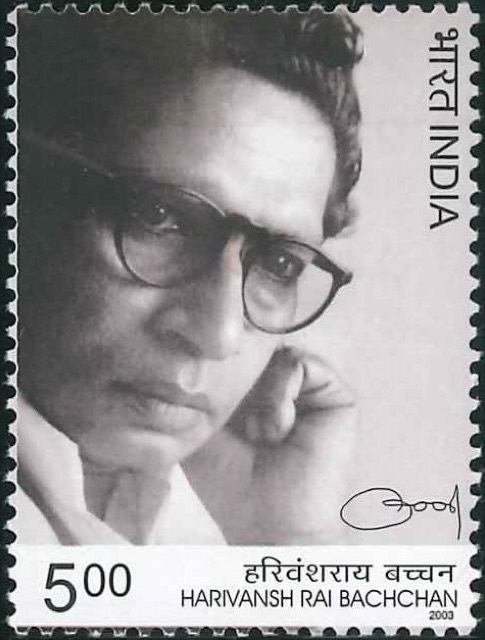
India Post, GODL-India, via Wikimedia Commons
Quick answer: Harivansh Rai Bachchan (1907-2003) wrote Madhushala, Agneepath and Jo Beet Gayi So Baat Gayi. His life from Allahabad to Cambridge, famous poems and legacy.
Quick facts
- Born: 27 November 1907, Allahabad (Prayagraj)
- Died: 18 January 2003, Mumbai
- Language: Hindi
- Known for: Madhushala and the Madhu trilogy
- Doctorate: Cambridge University, on the poetry of W. B. Yeats
- Honours: Sahitya Akademi Award 1968, Padma Bhushan 1976
In 1935 a young lecturer from Allahabad published Madhushala, a sequence of quatrains built entirely around the house of wine, and Hindi poetry acquired one of its most recited books. Harivansh Rai Bachchan, born in 1907, led the movement critics call Halavad, poetry of intoxication, and later earned a Cambridge doctorate on W.B. Yeats, translated Shakespeare into Hindi, and wrote a four-volume autobiography regarded as a classic of the language.
Bachchan's craft lesson is unfashionable and priceless: simplicity is a technique, not an absence of technique. He wrote for the listening ear, in plain Khari Boli Hindi, and trusted one extended metaphor to carry an entire book.
The people's lyricist
Bachchan arrived after Chhayavad had made Hindi poetry inward and ornate, and he swung the pendulum back toward the audience. Madhushala and its companion volumes, Madhubala and Madhukalash, used the Persian-inflected imagery of tavern, cup, wine and cupbearer, familiar from Omar Khayyam, whose Rubaiyat he had translated, to talk about longing, mortality and the strange sweetness of persisting.
He recited to enormous gatherings, and the poems were built for it: end-stopped quatrains, a refrain word closing each stanza, rhythm you could anticipate. Later came the harder, barer poems, including 'Agneepath', a short exhortation to walk through fire without asking for shade, which remains a touchstone of resolve in Hindi. He served in the External Affairs Ministry and was nominated to the Rajya Sabha; he died in 2003.
The signature moves
His devices are few, deliberate and repeatable, which is exactly why they teach well.
- The single governing metaphor: Madhushala holds one image system, the tavern, for over a hundred quatrains, renewing it stanza by stanza with new angles rather than new imagery.
- The refrain anchor: each Madhushala quatrain lands on the same final word, turning the book into a litany and making every stanza feel complete yet serial.
- Radical plainness: vocabulary a schoolchild knows, syntax that never tangles, so the complexity lives in implication rather than diction.
- The recitation test: lines shaped for breath and memory, with strong end-stops and symmetrical phrasing that survive a noisy hall.
What you can learn
Try the governing-metaphor exercise. Choose one image system, a railway station, a kitchen, a harbour, and write ten quatrains that never leave it. The discipline forces invention: by stanza six you are done with the obvious angles and the real discoveries begin. This is how a metaphor becomes a world instead of a decoration.
Then apply his plainness audit. Circle every word in your draft that you would not say aloud to a friend, and replace it unless it is doing irreplaceable work. Bachchan proves that emotional depth and verbal simplicity are not opposites. If you want an external check, entries in Writory's monthly contest are scored partly on language and emotion, and plainly worded poems with a strong governing image consistently score better than ornate ones with none.
Where to start reading
Madhushala first, ideally heard in recitation as well as read; recordings are easy to find. 'Agneepath' shows the compressed later manner. His Hindi rendering of the Rubaiyat of Omar Khayyam reveals the source of the tavern imagery, and the autobiography, beginning with Kya Bhulun Kya Yaad Karun, is one of modern Hindi's great prose works and a candid record of a poet's making.
From Allahabad to Cambridge and back
Bachchan's life had the shape of one of his own poems: setback, vow, climb. A Kayastha schoolmaster's son from Allahabad, he taught English at Allahabad University, lost his first wife Shyama in 1936, and answered a decade of grief with some of Hindi's most quoted lines about carrying on. In 1952 he went to Cambridge and became one of the first Indians to take a doctorate in English literature there, writing on Yeats, then came home and chose Hindi anyway, joining the External Affairs Ministry to serve the language officially.
The surname the world knows was his invention: Bachchan, meaning child-like, was his pen name before it became the family name his son Amitabh carried into cinema. The autobiography he wrote across four volumes, beginning with Kya Bhooloon Kya Yaad Karoon, is itself counted among Hindi's great books: poets rarely write their lives this honestly.
Famous poems by Harivansh Rai Bachchan
- Madhushala (1935): The tavern: 135 quatrains in which wine, cup, saki and tavern become metaphors for everything, God, love, death, politics. Recited at gatherings for ninety years and never out of print.
- Agneepath: The path of fire: a father's iron vow of struggle without rest. Later generations met it through the films that borrowed its title, but the poem's force is all Bachchan's.
- Jo Beet Gayi So Baat Gayi: What has passed is past: Hindi's most consoling poem about loss, reasoned like a friend talking you through the worst night of your life.
- Nid Ka Nirman Phir-Phir: Build the nest again and again: resilience learned personally, written after grief had taken his first wife Shyama.
- Madhubala and Madhukalash (1936): The second and third books of the Madhu trilogy, riding the intoxication of Madhushala into new registers.
Life at a glance
- 1907: Born in Allahabad.
- 1935: Recites Madhushala at kavi sammelans and becomes famous almost overnight.
- 1936: His first wife Shyama dies of tuberculosis; the grief shapes years of poems.
- 1941: Marries Teji Suri; teaches English literature at Allahabad University.
- 1952: Leaves for Cambridge and earns a doctorate on W. B. Yeats.
- 1955: Joins the Ministry of External Affairs as a Hindi specialist; later nominated to the Rajya Sabha in 1966.
- 1976: Padma Bhushan.
- 2003: Dies in Mumbai at 95; the country recites Madhushala back to him in farewell.
What poets can take from this
- Write ten quatrains inside a single image system without leaving it once.
- End every stanza of a sequence on the same word and let the repetition accumulate meaning.
- Replace any word you would not say aloud to a friend unless nothing else will do.
- Test drafts by reciting from memory; the lines you forget are usually the lines to cut.
- Let one short poem state its resolve directly, without irony, and see if it holds.
Try it yourself
Pick an everyday building, a tea stall, a station, a laundry, and write eight quatrains in which it becomes a philosophy of life. Every stanza must end on the same noun, and no word may need a dictionary.
Questions
What is Madhushala about?
On the surface it is a sequence of quatrains about a tavern, its wine, cup and cupbearer. The imagery works as an extended metaphor for longing, faith, death and the intoxication of living, which is why readers of every persuasion adopted it.
Was Harivansh Rai Bachchan a scholar as well as a poet?
Yes. He taught English at Allahabad University, completed a Cambridge doctorate on W.B. Yeats, and translated works including Shakespeare's plays and the Rubaiyat of Omar Khayyam into Hindi.
What does 'Agneepath' mean?
The title means path of fire. The poem is a short, stern exhortation to keep walking through hardship without asking for comfort, and it has become proverbial in Hindi.
What is Harivansh Rai Bachchan famous for?
He is famous for Madhushala, the 1935 sequence of 135 quatrains that made him a household name, and for poems of resolve and consolation like Agneepath and Jo Beet Gayi So Baat Gayi. He also wrote a celebrated four-volume autobiography and was the father of actor Amitabh Bachchan.
Was Amitabh Bachchan's father a poet?
Yes. Amitabh Bachchan is the elder son of Harivansh Rai Bachchan, one of modern Hindi's most loved poets. The actor has often recited his father's poems, including Agneepath and Madhushala, in public and on film.
By the Writory editorial team, reviewed by working poets. Updated September 2026.
Enter a Writory poetry contest
Enter the October contest and have your own poem read and scored. That first entry makes you a Writorian.