Kuvempu
1904 to 1994
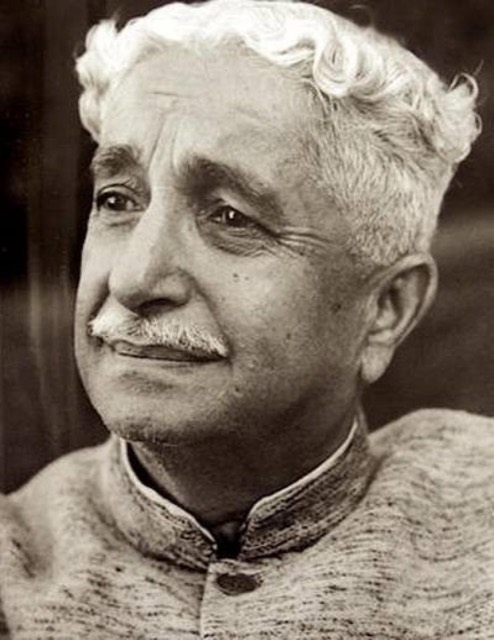
Public domain, via Wikimedia Commons
Quick answer: Kuvempu (1904-1994) wrote Sri Ramayana Darshanam and Karnataka's state anthem, and won Kannada's first Jnanpith. His life, famous poems and legacy.
Quick facts
- Full name: Kuppali Venkatappa Puttappa
- Born: 29 December 1904, Malnad region of Karnataka; raised at Kuppali
- Died: 11 November 1994, Mysuru
- Language: Kannada
- Known for: Sri Ramayana Darshanam, the Karnataka state anthem, the vishwamanava ideal
- Honours: Jnanpith 1967, Rashtrakavi 1964, Padma Vibhushan 1988, Karnataka Ratna 1992
Kuvempu is the pen name of Kuppali Venkatappa Puttappa, born in 1904 in the rain-heavy Malenadu region of the Western Ghats, and the towering figure of twentieth-century Kannada literature. In 1967 he became the first Kannada writer to receive the Jnanpith Award, for his epic Sri Ramayana Darshanam, and Karnataka honoured him as Rashtrakavi, poet of the nation.
For a practising poet, Kuvempu answers a question most of us quietly carry: can you write from a small place in a regional language and still address the whole species? His answer, worked out across an epic, lyrics, novels and essays, was an emphatic yes.
The epic ambition of a village-born poet
Kuvempu came from Kuppali, a village amid forested hills, and studied in Mysore, where he later rose to become vice-chancellor of the university. He championed education in Kannada at a time when English dominated, and his intellectual signature is the idea of the vishwamanava, the universal human: the conviction that every child is born universal and is then narrowed by caste, creed and sect.
His central poetic act was audacious: retelling the Ramayana as a modern epic. Sri Ramayana Darshanam, completed in 1949, runs to tens of thousands of lines in a flexible blank-verse manner rather than classical rhymed metres, and it rethinks the inherited story through a humanist lens, dignifying characters the tradition had judged harshly. One of his songs, 'Jaya Bharata Jananiya Tanujate', was adopted as the official state song of Karnataka.
The signature moves
Kuvempu's craft can be observed at three scales: the epic, the lyric and the sentence.
- Epic revision: he kept the inherited story's architecture but re-argued its morality, letting modern conscience interrogate ancient plot instead of merely decorating it.
- Unrhymed momentum: his flexible blank-verse line freed Kannada narrative poetry from ornament-heavy convention, proving a modern epic could move at the speed of thought.
- Malenadu grounding: mist, monsoon, forest and hill recur so persistently that the landscape functions as a character and a theology; his nature is sacred without being vague.
- The universal frame: local detail is constantly widened to species-level address, so a poem about one hillside ends up speaking about the human condition.
What you can learn
Try epic revision at lyric scale. Take a story your community considers settled, a myth, a folk tale, a family legend, and retell one scene from the perspective of its least defended character. Keep the plot, change the judge. This is Kuvempu's central move and it works in fourteen lines as well as in twenty thousand.
Ground your universals. Kuvempu never writes humanity in the abstract first; he writes the specific rain on a specific hill, then widens. Draft the local image before you permit yourself the large claim, and make the claim earn its place by arriving late. Finally, take his language loyalty seriously: if you grew up between languages, the one you dream in probably holds images the other cannot reach. Write at least some drafts there.
Where to start reading
Sri Ramayana Darshanam is the summit, available in English translation, though even a summary study of its choices is instructive. 'Jaya Bharata Jananiya Tanujate' shows the public lyric. His two great novels, Kanooru Heggadithi and Malegalalli Madumagalu, are prose but display the same Malenadu world-building poets can learn from, and his memoir Nenapina Doniyali records the making of the writer. Anthologies of modern Kannada poetry in translation carry his shorter lyrics.
The universal human
Kuvempu's deepest idea was vishwamanava, the universal human. Every child, he said, is born universal and is then shrunk by caste, creed and category; the purpose of education and poetry is to return the person to that first wholeness. He preached it plainly: leave every rigid system, become anikethana, unhoused, at home everywhere. The idea runs under everything he wrote, from the epic to the smallest lyric.
He lived the argument too. A Shudra farm family's son who rose to head Mysore University, he insisted on Kannada as a language of knowledge when English was the unquestioned ladder, and his two novels, Kanuru Heggadithi and Malegalalli Madumagalu, put Malnad's villagers, rains and forests at the centre of serious literature. Karnataka's reverence for him is not only for the poems; it is for the permission he gave the language to think big.
Famous poems by Kuvempu
- Jaya Bharata Jananiya Tanujate: Victory to you, daughter of Mother India: now the official state anthem of Karnataka, sung at every public function in the state.
- Sri Ramayana Darshanam (1949): His epic vision of the Ramayana in modern Kannada, where even Ravana is given inner life. It won Kannada its first Jnanpith.
- O Nanna Chetana: O my spirit: the Anikethana poem, a credo of endless becoming that asks the soul to live unhoused by any dogma. Schoolchildren across Karnataka know it.
- Doni Sagali Munde Hogali: Let the boat sail on: a river song of moving forward that became one of the most sung Kannada poems.
- Bommanahalliya Kindarijogi: His playful retelling of the Pied Piper for Kannada children, evidence that the epic poet could also be the most fun in the room.
Life at a glance
- 1904: Born in the Malnad hills; grows up at Kuppali amid the rain forests that flood his poems.
- 1929: Begins teaching at Maharaja College, Mysore.
- 1936: Kanuru Heggadithi, the first of his two great novels of Malnad life.
- 1949: Completes Sri Ramayana Darshanam.
- 1956: Becomes Vice-Chancellor of Mysore University and champions Kannada as the medium of learning.
- 1964: Honoured as Rashtrakavi, poet of the nation.
- 1967: Jnanpith Award for Sri Ramayana Darshanam, the first ever for Kannada.
- 1994: Dies at Mysuru; his birthplace Kuppali is now a place of literary pilgrimage.
What poets can take from this
- Retell one scene from a settled story through the eyes of its least defended character.
- Write the local image first; allow the universal statement only after it is earned.
- Let one landscape recur across several poems until it becomes a character with moods.
- If you are multilingual, draft in the language you dream in, then translate yourself.
- For narrative poems, try unrhymed lines and let the story's logic supply momentum.
Try it yourself
Choose a figure from a myth or family story who is usually blamed, and write a 20-line monologue in their voice, set in the landscape you know best. Keep the traditional events intact but let the speaker question the verdict.
Questions
What is Kuvempu's most famous work?
Sri Ramayana Darshanam, his modern Kannada epic retelling of the Ramayana, is his masterpiece and won him the Jnanpith Award in 1967, the first for a Kannada writer. His song 'Jaya Bharata Jananiya Tanujate' is Karnataka's state song.
What does vishwamanava mean?
It is Kuvempu's concept of the universal human. He argued that every child is born universal and becomes narrowed by labels of caste, religion and community, and that education and literature should restore that universality.
What is Kuvempu famous for?
Kuvempu is famous as modern Kannada's greatest poet: author of the epic Sri Ramayana Darshanam, winner of Kannada's first Jnanpith Award in 1967, and writer of Jaya Bharata Jananiya Tanujate, the official state anthem of Karnataka. He was named Rashtrakavi in 1964.
Did Kuvempu write the Karnataka state anthem?
Yes. His poem Jaya Bharata Jananiya Tanujate, which addresses Karnataka as the daughter of Mother India, was officially adopted as the state anthem, and it is sung at public functions across Karnataka.
By the Writory editorial team, reviewed by working poets. Updated September 2026.
Enter a Writory poetry contest
Enter the October contest and have your own poem read and scored. That first entry makes you a Writorian.