Suryakant Tripathi Nirala
1896 to 1961
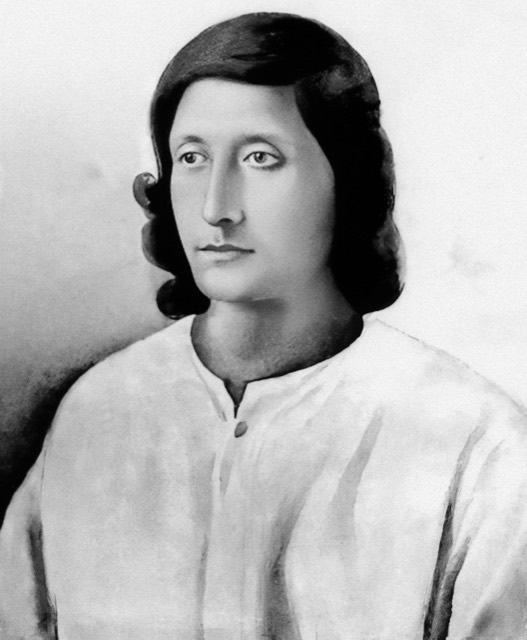
Public domain, via Wikimedia Commons
Quick answer: Suryakant Tripathi Nirala (1896-1961) freed Hindi verse and wrote Saroj Smriti and Ram Ki Shakti Puja through a life of loss. His story, famous poems and legacy.
Quick facts
- Full name: Suryakant Tripathi
- Pen name: Nirala, the strange one
- Born: 1896, Midnapore district, Bengal; family from Gadhakola, Unnao, UP
- Died: 15 October 1961, Allahabad
- Movement: Chhayavaad, one of its four pillars
- Known for: Saroj Smriti, Ram Ki Shakti Puja, free verse in Hindi
Suryakant Tripathi took the pen name Nirala, meaning the strange or singular one, and then spent a lifetime earning it. Born in 1896 in Midnapore, Bengal, and writing in Hindi through the first half of the twentieth century, he did something poets in every language eventually attempt: he broke the metre when the metre stopped serving the feeling. Hindi criticism generally credits him with establishing mukt chhand, free verse, as a serious mode in the language.
This guide treats Nirala as a teacher rather than a monument. You will find the specific techniques a working poet can lift from his poems, from his elastic line to his unsentimental portraits of the poor, along with a short reading list to test each move against the original.
The rebel of Chhayavad
Nirala belongs to Chhayavad, the romantic movement that remade Hindi poetry in the 1920s and 1930s. He is usually named alongside Jaishankar Prasad, Sumitranandan Pant and Mahadevi Varma as one of its four pillars. Where the movement as a whole favoured shadowy suggestion and inward feeling, Nirala kept one foot in the street. His life was marked by early bereavements, long poverty and quarrels with the literary establishment, and all three pressures show up in the work.
His early poem 'Juhi Ki Kali' announced the break: a love lyric in lines that refused a fixed syllable count, famously turned down by a conservative editor before finding readers elsewhere. From then on he moved between grand mythological subjects and figures nobody else was writing about, a beggar, a woman breaking stones by the roadside, his own dead daughter.
The signature moves
Four techniques recur across his strongest poems, and each one is observable on the page even in translation.
- The elastic line: in his free verse the line lengthens when emotion swells and snaps short when it breaks, so rhythm tracks feeling rather than a syllable count.
- Register switching: 'Ram Ki Shakti Puja' piles up long Sanskritised compounds for epic weight, while 'Bhikshuk' and 'Wo Todti Patthar' use plain spoken Hindi; he chose diction per subject, not per habit.
- Portraiture without pity: the stone-breaking woman in 'Wo Todti Patthar' is rendered through posture, tools, heat and glance, never through editorial sighing over her fate.
- Elegy that argues: 'Saroj Smriti', written for his daughter who died young, does not only mourn; it protests, remembers domestic detail, and turns grief into a reckoning with his own failures.
What you can learn
Start with the elastic line. Take a metrical draft of your own and re-break it so that line length follows the pressure of the sentence: long where the thought runs, abrupt where it halts. Free verse is not the absence of rules, it is rhythm decided poem by poem, and Nirala is one of the clearest demonstrations of that principle in any Indian language.
Then try his portraiture discipline. Write about a person doing hard work using only what a camera and microphone could record. No adjectives of pity, no stated moral. Nirala trusts the image of a hammer falling in noon heat to do the arguing. Finally, borrow his elegiac honesty: when writing grief, include the guilt and the ordinary memories, not just the sorrow. The mixed feeling is what convinces.
Where to start reading
Begin with 'Wo Todti Patthar' for the portrait method, then 'Bhikshuk' for compassion handled without softness. 'Juhi Ki Kali' shows the early free-verse breakthrough. 'Ram Ki Shakti Puja' is the epic register at full stretch, and 'Saroj Smriti' is among the great elegies of modern Hindi. His collections Parimal, Anamika and Geetika gather the shorter lyrics. Good English translations exist in various anthologies of modern Hindi verse; reading two versions of the same poem side by side is itself a craft lesson.
A life the poems had to survive
Nirala's biography reads like a test of how much a person can lose and keep writing. The 1918 influenza pandemic took his wife and several of his family in one terrible season; he later wrote that the Ganga was swollen with dead bodies, his own people among them. His daughter Saroj, whom he raised through poverty, died at nineteen, and the elegy he wrote for her, Saroj Smriti, turns a father's helplessness into the most unbearable poem in modern Hindi.
He answered institutions the same way he answered grief: on his own terms. He fought editors over free verse, mocked literary Delhi, gave away money he did not have to anyone poorer, and spent his last years at Daraganj in Allahabad, half-legend and half-destitute. Hindi has never fully decided whether it looked after Nirala or failed him, which is one reason the poems still burn.
Famous poems by Suryakant Tripathi Nirala
- Juhi Ki Kali: The jasmine bud: the early poem whose loosened metre scandalised the editors of its day and announced that Hindi verse was about to change.
- Saroj Smriti (1935): The elegy for his daughter Saroj, dead at nineteen: Hindi's most devastating personal poem, in which a father counts everything he could not give.
- Ram Ki Shakti Puja (1936): Ram's worship of Shakti on the night his arrows fail: the Chhayavaad epic in miniature, where even God must earn power through despair.
- Wo Todti Patthar: She breaks stones: a labouring woman on an Allahabad road in summer, seen without pity or ornament. A founding poem of Hindi's social conscience.
- Bhikshuk: The beggar: hunger walking on two burnt feet. Generations of students meet Hindi realism here first.
- Kukurmutta (1942): The mushroom mocks the pampered rose: class satire in street language, decades ahead of its time.
Life at a glance
- 1896: Born in Bengal's Midnapore district, to a family from Gadhakola village in Unnao, United Provinces.
- 1918: The influenza pandemic takes his wife Manohara Devi and several family members within months; he is left with two small children.
- 1923: Edits Matvala in Calcutta; the fights over free verse begin.
- 1935: His daughter Saroj dies at nineteen; Saroj Smriti follows, grief mastered into permanence.
- 1936: Ram Ki Shakti Puja.
- Last years: Lives at Daraganj in Allahabad in poverty and failing mental health, still writing, still giving away what little he has.
- 1961: Dies at Allahabad on 15 October.
What poets can take from this
- Re-break one of your metrical drafts so line length follows emotional pressure instead of a fixed count.
- Write a labour portrait using only observable detail; cut every word that tells the reader how to feel.
- Match diction to subject: try one poem in your plainest speech and one in your most formal register in the same week.
- In an elegy, include one memory that embarrasses you; Nirala's grief poems work because they refuse to flatter the mourner.
- Read a Nirala poem aloud in translation and mark where the lines shorten; notice what the shortening does to your breath.
Try it yourself
Watch someone doing repetitive physical work for ten minutes. Write a poem of 12 to 20 lines that records posture, tools, weather and one exchanged glance, with no abstract nouns and no stated sympathy. Let the final line change length sharply.
Questions
Why is Nirala credited with free verse in Hindi?
His early poems, notably 'Juhi Ki Kali', abandoned fixed syllabic metres in favour of lines shaped by feeling, and he defended the practice in essays and prefaces. Hindi critics broadly treat him as the poet who made mukt chhand respectable.
What is 'Saroj Smriti' about?
It is a long elegy for his daughter Saroj, who died young. The poem mixes mourning with memory and self-reproach, and it is widely taught as a landmark of modern Hindi elegy.
Was Nirala part of a movement?
Yes, he is counted among the four major poets of Chhayavad, the Hindi romantic movement, together with Prasad, Pant and Mahadevi Varma. His social subjects and formal rebellion also pushed beyond the movement's usual borders.
What is Nirala famous for?
Nirala is famous as one of the four pillars of Chhayavaad and the liberator of Hindi verse from fixed metre. His masterpieces include Saroj Smriti, the elegy for his daughter, Ram Ki Shakti Puja, Wo Todti Patthar and the satire Kukurmutta.
Why is he called Nirala?
Nirala means the strange or unique one. The pen name fit both the poetry and the man: he broke metre when that was scandalous, dressed and lived by nobody's rules, and made Hindi accept that a poem's discipline can live in rhythm and image rather than in counted syllables.
By the Writory editorial team, reviewed by working poets. Updated September 2026.
Enter a Writory poetry contest
Enter the October contest and have your own poem read and scored. That first entry makes you a Writorian.