Thiruvalluvar
Between the 1st century BCE and the 5th century CE (dates debated)
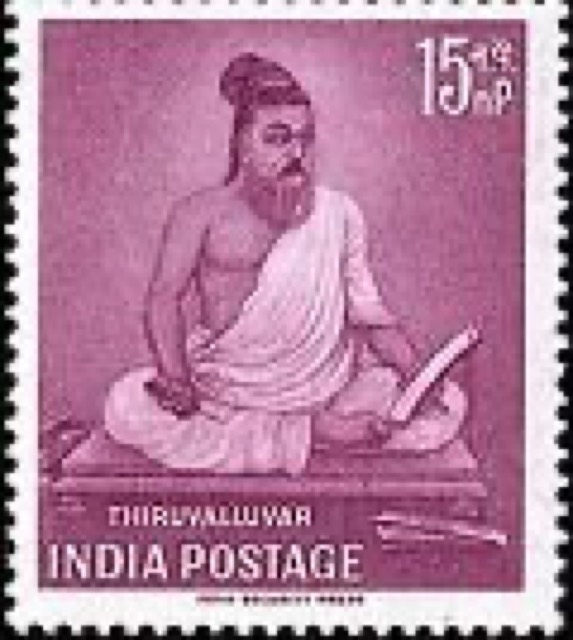
India Post, public domain, via Wikimedia Commons
Quick answer: Thiruvalluvar wrote the Tirukkural: 1,330 couplets on virtue, wealth and love that Tamil holds sacred. His life, the legends around him, and his famous couplets.
Quick facts
- Known for: The Tirukkural
- Form: 1,330 kural couplets in 133 chapters of ten
- Three books: Aram (virtue), Porul (wealth), Inbam (love)
- Traditional home: Mylapore, in present-day Chennai
- Honoured by: The 133-foot statue at Kanyakumari, one foot per chapter
- Celebrated on: Thiruvalluvar Day, mid-January
The Tirukkural may be the most efficient long poem ever written. Its author, Thiruvalluvar, composed 1,330 couplets in classical Tamil, each just seven metrical units long, and organised them into 133 chapters of ten, covering virtue, statecraft, wealth and love. Scholars debate his dates, placing him anywhere from the first century BCE to the fifth century CE, and tradition remembers him as a weaver of Mylapore. The work itself is the biography that matters.
What makes the Kural extraordinary for a practising poet is not just compression but neutrality: it praises no single god by name and belongs to no sect, which is why Jains, Hindus, Buddhists and modern secular readers have all claimed it. Writing that travels this far, this long, has design principles worth stealing.
Who he was
Almost nothing is documented about Thiruvalluvar's life; legends supply a weaver's trade, a wife named Vasuki and a home near present-day Chennai, where a 133-foot statue now stands at Kanyakumari, one foot for each chapter. The poem is counted among the greatest works of the Sangam-era Tamil tradition's aftermath and has been translated into scores of languages.
Its three books treat aram, right conduct; porul, wealth, politics and public life; and inbam, love. That an ancient ethical treatise ends with some of literature's most playful love poetry tells you the author refused to separate wisdom from delight.
The signature moves
The Kural's method is astonishingly consistent across 1,330 verses.
- The kural venba: a two-line form of four feet then three, small enough to memorise in seconds, sturdy enough to hold a complete thought with no spillage.
- Image then verdict: typically one line offers a concrete observation, rain, a plough, an anklet, a glance, and the other delivers the general truth it proves.
- Chapter as lens: ten couplets circle one topic, gratitude, procrastination, sulking between lovers, each approaching from a fresh angle, so the architecture does the elaborating that each couplet refuses to do.
- Sectless address: virtue is argued from consequence and common experience, not authority, which keeps the poems open to any reader in any century.
What you can learn
Set yourself a syllable budget and keep it. Write ten couplets on one theme, each under twelve words, each pairing a concrete image with a stated truth. You will discover how much of your usual writing is throat-clearing. The chapter-of-ten exercise also teaches angles: by couplet seven you are forced past your first thoughts into genuinely fresh approaches.
Practise sectless argument too. Take a conviction you hold and defend it in verse using only observable consequence, no appeals to authority, identity or fashion. Poems built this way age well, and they tend to score strongly on theme and language when judged blind, as entries are in Writory's monthly contest.
Where to start reading
Any complete translation shows the architecture; well-known English versions range from G. U. Pope's Victorian rendering to modern translations by P. S. Sundaram and the recent version by Thomas Hitoshi Pruiksma. Start with Book One's chapters on rain, gratitude and truthfulness, then jump to Book Three, the love poems, to hear the same form turn flirtatious. Reading one chapter of ten in a sitting, rather than random couplets, reveals the design.
The weaver of Mylapore
Almost nothing about Thiruvalluvar's life is documented, and Tamil tradition has filled the silence with love. He is usually said to have been a weaver who lived at Mylapore, now a neighbourhood of Chennai, and stories of his household with his wife Vasuki are told as parables of patience and equality. Every community in Tamil Nadu has at some point claimed him, which may be the point: the Kural avoids naming any sect, any caste, any king, as if its author had decided in advance to belong to everyone.
The honorific tells you how Tamil culture ranks him: Thiru means holy, and Valluvar may name his community of weavers or drummers. The text itself is treated as scripture without a religion, sworn on in courtrooms, quoted in the legislature, and taught to every schoolchild in Tamil Nadu.
Famous poems by Thiruvalluvar
- The opening kural: Agara mudhala: All letters begin with A; the world begins with God. Two lines that give the whole book its compass, and the first Tamil many children memorise.
- Vaan Sirappu, the chapter on rain: Ten couplets that treat rain as the world's quiet benefactor, the condition of virtue itself: no rain, no offering, no ploughing, no ethics.
- Kalvi, the chapter on learning: Learning is the wealth no flood or fire touches. The couplets Tamil parents still quote at their children.
- Uzhavu, the chapter on farming: Those who plough, eat as their right; everyone else follows behind. The Kural's respect for labour, two thousand years early.
- The Inbam book: The third book: 250 couplets of lovers' quarrels, longing and reunion, proof that the moralist could also write the most delicate love poetry in old Tamil.
Life at a glance
- c. 1st century BCE to 5th century CE: The Tirukkural is composed; scholarship still debates the century.
- 1812: The Kural is printed for the first time, among the earliest Tamil books ever printed.
- 1886: G. U. Pope completes the first full English translation, introducing the Kural to the world.
- 2000: The 133-foot Thiruvalluvar statue is unveiled at Kanyakumari, one foot for each chapter.
- Today: The Kural stands translated into more than 40 languages, among the most translated non-religious works on earth.
What poets can take from this
- Give every couplet a hard word budget and let no thought spill past line two.
- Pair one concrete image with one general truth and cut everything between.
- Write ten poems on a single narrow theme to force yourself past first angles.
- Argue from observable consequence, never from authority.
- Test compression by deleting any word and checking whether meaning survives.
Try it yourself
Choose one small virtue or fault, punctuality, sulking, borrowed money, unwatered plants, and write a chapter of ten two-line poems about it, each under twelve words, each viewing the subject from a different angle.
Questions
What is the Tirukkural?
A classical Tamil work of 1,330 couplets by Thiruvalluvar, arranged in 133 chapters of ten and covering ethics, public life and love. It is revered across religious traditions and widely translated.
When did Thiruvalluvar live?
Nobody knows precisely. Scholarly estimates range from around the first century BCE to the fifth century CE, and reliable biographical detail is essentially nonexistent, leaving the poem itself as his record.
What is a kural?
It is a very short Tamil couplet in the venba metre, with a four-foot first line and a three-foot second line. The form's extreme brevity forces one complete, memorable thought per poem.
What is Thiruvalluvar famous for?
Thiruvalluvar is famous as the author of the Tirukkural, 1,330 two-line couplets on virtue, wealth and love composed in ancient Tamil. It is among the most revered and most translated works in any Indian language, often called the Tamil Veda.
How many couplets are in the Tirukkural?
Exactly 1,330 couplets, arranged in 133 chapters of ten. The chapters divide into three books: Aram on virtue, Porul on wealth and governance, and Inbam on love.
By the Writory editorial team, reviewed by working poets. Updated September 2026.
Enter a Writory poetry contest
Enter the October contest and have your own poem read and scored. That first entry makes you a Writorian.